Forecasting high-risk areas of covid-19 infection through socioeconomic and static spatial analysis
Abstract
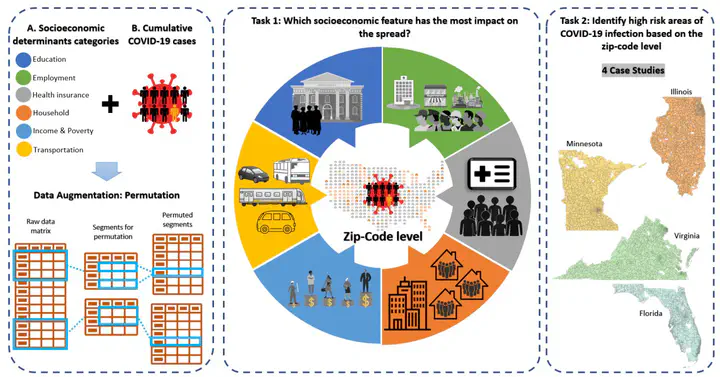
Existing COVID-19 prediction models focus on studying the dynamic nature of the virus spread by using pandemic-related temporal data. In this paper, we present a work that exclusively uses comprehensive socioeconomic factors to predict the high risk areas of COVID-19 infection based on fine-grained static spatial analysis. Moreover, the most and least influential socioeconomic factors on COVID-19 spread are identified. This paper uses a uniquely built dataset by combining local states’ cumulative COVID-19 statistics and their associated socioeconomic features on the zip code level. Further, the work solves the lack of data by augmentation. To evaluate the work, four case studies are conducted on Florida, Illinois, Minnesota, and Virginia. Experimental results show that the study provides accurate predictions with respect to ground truth data. By identifying high risk areas and socioeconomic factors, policymakers can use this study to take necessary measures to help disadvantaged communities.

Abdulaziz Alhamadani عبدالعزيز الهمداني
PhD Candidate
My research interests include ML applications, text classification, event detection, pandemic forecasting, and ethical AI.